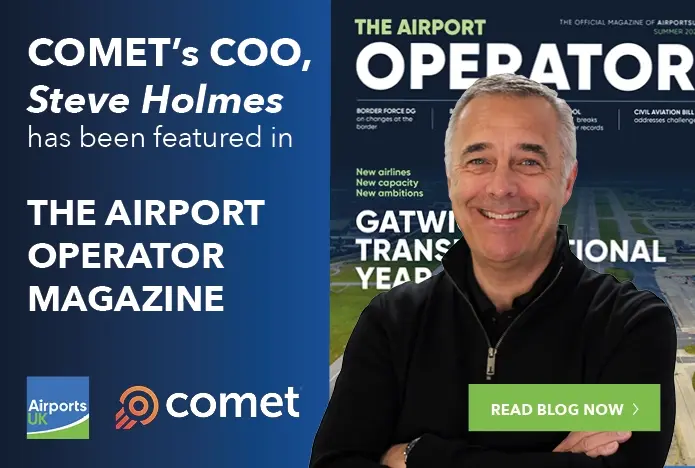
Aviation has earned its safety record the hard way. Decades of sustained commitment to crew resource management, human factors training, and the development of increasingly sophisticated safety management frameworks have made commercial flight one of the safest activities in the modern world. It is an achievement that Steve Holmes, COO at incident investigation and root cause analysis specialists COMET, is quick to acknowledge.
“The industry deserves real credit for what it has built,” he says. “The regulatory frameworks, the safety culture, the willingness to report and learn from events. That foundation is genuinely world-class. What we are talking about now is building on that, not completely changing it.”
The opportunity Steve has in mind sits at the intersection of investigation quality and data intelligence, and it applies across the full breadth of aviation operations: airlines, airports, ground handlers, and everyone in between.
The gap between intent and outcome
Despite the strength of aviation’s safety culture, Steve points to a pattern that safety leaders across the sector will recognise. Incident reporting volumes are healthy, investigations are conducted, actions are assigned. Yet the same failure types can recur in the same operational areas, involving the same contributing factors.
“That is rarely a failure of effort,” he is careful to say. “The people running these safety programmes care deeply. What we see more often is a gap in methodology and infrastructure. The investigation process answers the question of what happened and who was involved. It does not always get to why it happened, and what systemic conditions made it possible.”
The most common point of breakdown, in Steve’s experience, is the treatment of human error as an endpoint rather than a starting point. When an investigation concludes that a ground handler failed to follow a procedure, or that an operative made an error of judgement under pressure, it has identified a symptom, not a cause.
“Human error is where the investigation should begin, not where it should stop,” he says. “ The real question is what conditions, pressures, training gaps, or system weaknesses made that error not just possible but likely. Without structured human factors analysis embedded in the process, those conditions stay in place. And they produce the next event.”
A second area of opportunity lies in how near misses and lower severity events are treated. Steve is direct on this point: “Near misses are not background noise. The root causes behind a near miss and a fatality are very often identical. The difference is circumstance and timing. If you are only investigating your most serious events with genuine rigour, you are missing the earliest and most actionable signals in your safety data.”
The role of AI in finding what humans cannot
This is where Steve believes technology, and specifically artificial intelligence, is beginning to change what is possible for aviation safety leaders. Historically, incident investigation has been a human-led, case-by-case process. Effective in many respects, but limited in its ability to harness the collective intelligence held across an organisation’s full data set. “AI introduces a new dimension,” says Steve. “It is something we have been working towards for some time, and just last month we launched the COMET AI Assistant, the only AI capability built specifically for incident investigation and root cause analysis. It works both inside individual investigations and across an entire portfolio of data over time, surfacing patterns and insights that no individual investigator could find on their own. It can answer questions that previously had no practical answer: which causal factors appear most frequently across high-severity incidents? Where is systemic risk accumulating? Which interventions are actually working? All through natural conversation. All you have to do is ask.
That capability does more than identify where systemic compliance gaps exist. It also surfaces pockets of genuinely good performance and the conditions that created them. “Understanding why some areas are performing well is just as valuable as understanding why others are struggling,” Steve explains. “It means you can replicate success, not just respond to failure. And it means preventive spend goes where it will actually make a difference, rather than where the most recent serious event happened to occur.”
What the right partnership delivers
COMET works in aviation as part of a three-way partnership with Intelex and Arcadis that Steve describes as genuinely end-to-end. Intelex provides the enterprise-grade safety management platform that captures, manages, and tracks incident data at scale across complex multi-site operations. COMET contributes the structured root cause analysis methodology, built by professional investigators, with human factors analysis embedded directly into the investigation workflow and AI-assisted analytics that turn coded investigation data into strategic prevention intelligence. Arcadis brings the aviation-specific implementation expertise and change management capability that ensures the technology is adopted and embedded across operational teams, not just deployed and left to find its own way.
“Together, the three of us link every report to a root cause, every root cause to a corrective action, and every corrective action to a measurable outcome,” Steve says. “That closed loop is what turns an investigation programme from a record-keeping exercise into something that genuinely reduces events over time.”
Aviation has always been an industry that looks honestly at where improvement is possible and acts on it. The investigation capability now available means that ambition has never been better equipped to deliver results.
Read the full Summer 2026 issue of The Airport Operator here. COMET's article starts at page 36!
Book a discovery call to see if COMET can help your organisation